
The Muay Thai (Thai language มวยไทย) also known as Thai Boxing or Thai Boxing is a combat sport that has its origins in Mae Muay Thai, Thai ancient art of combat. The Mae Mai Muay Thai fights studied both with and without weapons and was used by Thai warriors in the war, when they lost their weapons.
Currently the term Muay Thai today mainly identifies the sporting aspect of the martial art.
HISTORY: The
Muay Thai is a martial art more commonly known as Thai boxing. It spread since 1500, in the early days of peace the people of Siam (Thailand) when citizens organized events and meetings: it was the practice preferred by civilians, whether for leisure or for personal defense (then called Mae Mai Muay Thai ). Then they fought with no rules, no weight classes, no time limits, into submission, unconsciousness, or, tragically, the death of one of the contenders . Guards were not used except for a shell to protect the private parts and a rope wrapped around his knuckles. Sometimes this was mixed with a kind of glue and powdered glass, turning the meetings into real bloodshed.
 The modern martial art (also known as Thai Boxing and which approximates to the fees of sports such as boxing) as we know it Muay Thai was given to us during the reign of King Rama VI in 1921 (for the year BE 2464), with the introduction of gloves and rules precisely similar to those of Western boxing, (then already very popular in the wake of colonialism). The king commanded the general Praia Nontisen Surentara Pahdi to build a stadium in the Suan Kulaba college and organize competitions every Saturday. Over the years, Muay Thai has evolved into the sport dimension, coming to us today as a complete sport, which has lost its original features, its rituals from religious and social meanings, but the appearance enriched play.
this martial art in Thailand is considered the national sport, meetings and offer significant revenue opportunities to children who test themselves. It has often been observed that while the Thai fight often (at least at the beginning) to put together lunch and dinner, the stranger, (the so-called farang) practicing Muay Thai, they do more than just for money prize for the glory. In most encounters, and especially in the homeland, the Thai have been able to assert their superior experience compared to farang. Some Western fighter has been able to overcome but also at home, such as the Dutch legend Ramon Dekkers (known as the "Diamond"). Westerners in general show a certain advantage in the technique compared to Thai boxing, which appear insurmountable but for mobility, speed, strength and wise use of short range and deadly, elbows and knees. Recently, the sport is open to women, and with success: personal defense to competition from the step was short to not a few girls, especially in countries like Holland and France (already at highest level in the field male) and in the world Anglo-Saxon, but also in Japan and over the traditional strengths at home. Among the athletes Chantal Menard mention the French and Dutch and Valerie Henin Lucia Rijker Saskia Van Rijswijck.
Although today is considered a sport for all purposes, the Muay Thai is considered the most tough and challenging specialties in combat sports. In fact, as mentioned, is allowed to strike with all parts of the body (except head) almost all of the opponent and you can make some projections. In particular thaiboxer are feared for the use of elbow strikes, allowed almost exclusively in Thailand to their dangerousness.
In Italy Muay Thai has come for the first time in 1979 with Master Stephen Giannessi and now going through a phase of development. Over the years, "some 90 Italian athletes stood out in the international arena. A recent controversy is pitting supporters of the" standard "version of Muay Thai to those of Muay Boran. The latter, brought to Italy by Marco De Cesaris, is a sort of summa traditional techniques go gradually disappearing with the emergence of a Muay Thai inevitably "westernized" Twenty years from rules imposed by the forward and contact with boxing. Traditional techniques for in both the body of knowledge of Thai teachers and revived under the name of Muay Boran is then divided into regional styles: Muay Tha Sao (North), Muay Korat (or Isan region Northeast), Muay Lop Buri ( central region), Muay Chaiya (South). He says a traditional phrase: Punch (fist) Korat, Wit (cunning) Lopburi, Posture (position) Chaiya, Faster (speed) Thasao. Each of these regional schools has contributed over time to the development of art as a whole. Muay thai
The sport is promoted in Italy by the Italian Federation of Muay Thai David Carlot, president and managing officer for IFMA Italy, the only international federation recognized by GAISF-CIO, participates annually with the national team to world championships in this discipline .
FEATURES:
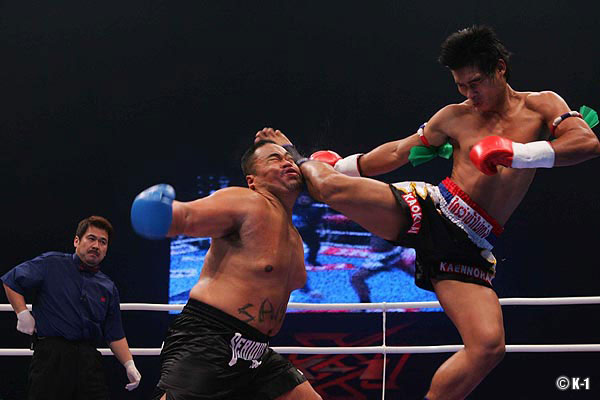
features of this martial art are the deadly blows with bones (which affect up to years of practice make it very hard), elbows and knees. Muay Thai is also known in English as "The science of the eight limbs" because it takes eight points body to hit: the hands, shins / feet, elbows and knees.
Unique is the conditioning to be applied to the parts used for stroke: a long and rather painful for beginners, which involves hitting the sack with a constant rate exercise hardness gradually increasing. The Thais even use certain kinds of local trees with smooth bark and the trunk is very flexible, but they seem to be favored by a physical structure different from departure typical of Westerners.
Thai professionals, often the children of poor families, they begin the practice of art young, making their first meetings as a child, about 9 years, to be considered athletes already fully mature on 20. Muay Thai is for the poor a way of personal and professional fulfillment. The physical training is among the most rigorous and exhausting every sport professionals observe strict discipline by training two to three hours twice a day for five to six days a week, running or swimming for miles, jumping rope, running on flex arms and legs, chins, exercises for the abdominals and neck muscles (important in chap ko or clinch, another aspect of Muay Thai, a phase of struggle in the foot to unbalance the opponent or get in his guard) and sneaking in round after round of refinement of the technique to pao or hitters, all under the eye careful expert instructors former combatants, or Ajarn kru. And, of course, the sparring (simulation meeting, a term taken from boxing), conducted with greater or lesser degree depending on the level achieved, the preparation and condition.
PHILOSOPHY OF RELIGION AND FOLKLORE:
MYTHOLOGY: originally handed down orally, the stories related to Muay Thai are often surrounded by a halo legendary. A popular legend tells that important Khanom Thom Nay, Prince inheritors of the kingdom of Siam in the current Thailand, was taken prisoner by Burmese gained freedom by impressing the king of Burma, beating unarmed twelve of the warriors Burmese stronger. Some versions say that he won, in addition to his freedom, including that of all the prisoners who were with him. 
This legend shows that for those who practice Muay Thai Nai Khanom Thom figure represents the very spirit of the fighter, the Nak Muay : he who does not surrender in front of adversity with courage and determination and that dominates the events. The tradition has set that day at March 17, which has become the day of Muay Thai.
Another striking character in the Thai tradition is the "Tiger King", whose real name was Pra Chao His. It is said that during his reign, the beginning of the eighteenth century, this sovereign were to go to the villages in disguise to find fighters to be addressed and thus measure its capacity.
RITUALS traditional and AMULETI: Before a fight a few Muay Thai fighters perform rituals: what is considered important in Thailand, at least in the West where the rituals are still observed as the country's cultural creative expression of art. Some fighters perform rituals outside the ring, others pray with their coach or their own account, for example by touching the strings of the ring 3 times. I always thaiboxer climb up to the last chord of the ring as you enter, in Thai culture, in fact, the head is considered more importance of the feet. Remember to always have his head in front of the foot as he enters the ring. Once inside the wrestler goes to the center of the ring and bow to each side. Now begins the Wai Kru ritual (or Khru Wrai ram muay). The Wai Kru usually starts with the fighter walking around the ring counter-clockwise, seen as a kind of "navigation of the ring, to show that the fight is solely and exclusively between the two fighters present. The ritual is both practical and spiritual meaning is a practical exercise that warms up the muscles and prepares the body for combat. In the Wai Kru are different movements and steps that a fighter should do before the fight along with stretching. Some motions imitate, for example, a hunter, a soldier, a performer. Some use the ritual to scare your opponent, usually by running around it, but in a deeper sense of the fighter shows religious devotion, humility and gratitude. Transcending the physical and temporal limitations, he opens himself to the divine presence and allows him to infuse his heart and his spirit. In ancient times, the ritual was intended to show devotion to the King and his mentor, now is the devotion given to the coach and the organizer of the meeting. The ritual also gives the fighter the opportunity to take some time before the meeting to collect his thoughts and concentrate. After the dance, the fighter goes to the coach who removes Mongkon and the Pong Malai. The encounter begins after a general review of rules by the referee and a shot of friendly gloves among the challengers.
 Mongkon: It 's a headband that served to protect and bring luck to the contestant who indassava. This protective amulet consists of a narrow strip of cloth containing magical letters and symbols that is rolled very tight, so you look like a rope (the size of a finger) and is tied with a sacred thread and protective: the "sai sin". Thus, the mongkon, is wrapped with a second strip of cloth previously blessed by a master of magic. Finally, the ends are tied together to form a small tail that, when the "mongkon" is placed on the head of the fighter, protrudes from the back of the head. The "mongkon" is worn during various rituals: for example, "kruu wai" (a small ritual conducted before the start of combat) and the "ram muay" (a dance that makes the first boxer to bow before his master). After the "ram muay", the mongkon is removed before the start of the first round of the match.
Today, mongkon used for classifying the degrees of master of Muay Thai.
 PRACIAT or PRAEJAT: It 's another protective amulet that can give strength, luck and to increase the resilience of the fighter. The consistency is similar to monkgon: the sacred thread woven in the form of rope with a small tail that joins the ends. Typically, these amulets were of a fine white cloth (pha Salu "), but could also be red or other colors, at the discretion of the master or second Spell sull'amuleto issued that contains magic numbers and symbols (" maha amnart "and" Chatri mahayanta). Unlike mongkon, the praciat are worn and tied around the biceps.

0 comments:
Post a Comment